



Importing from China can look intimidating the first time — unfamiliar suppliers, ocean freight, customs paperwork, and a language barrier that hides real risks. But the process is far more repeatable than it seems. Tens of thousands of retailers, wholesalers, and e-commerce sellers import from China every month using a clear, step-by-step playbook.
This guide walks you through how to import from China from zero: researching a product, finding and vetting suppliers, pricing with Incoterms, inspecting quality, shipping, clearing customs, and scaling into a reliable supply chain. Whether you run a Shopify store, stock a retail shelf, or supply a supermarket chain, the fundamentals below apply.
Who this is for: B2B buyers placing real wholesale orders. Toptrade works with importers whose order value starts around $5,000 (and $20,000+ for supermarket chains). We do not handle single-unit dropshipping or hobbyist purchases — the playbook below assumes commercial volumes.
Why Import from China in the First Place?
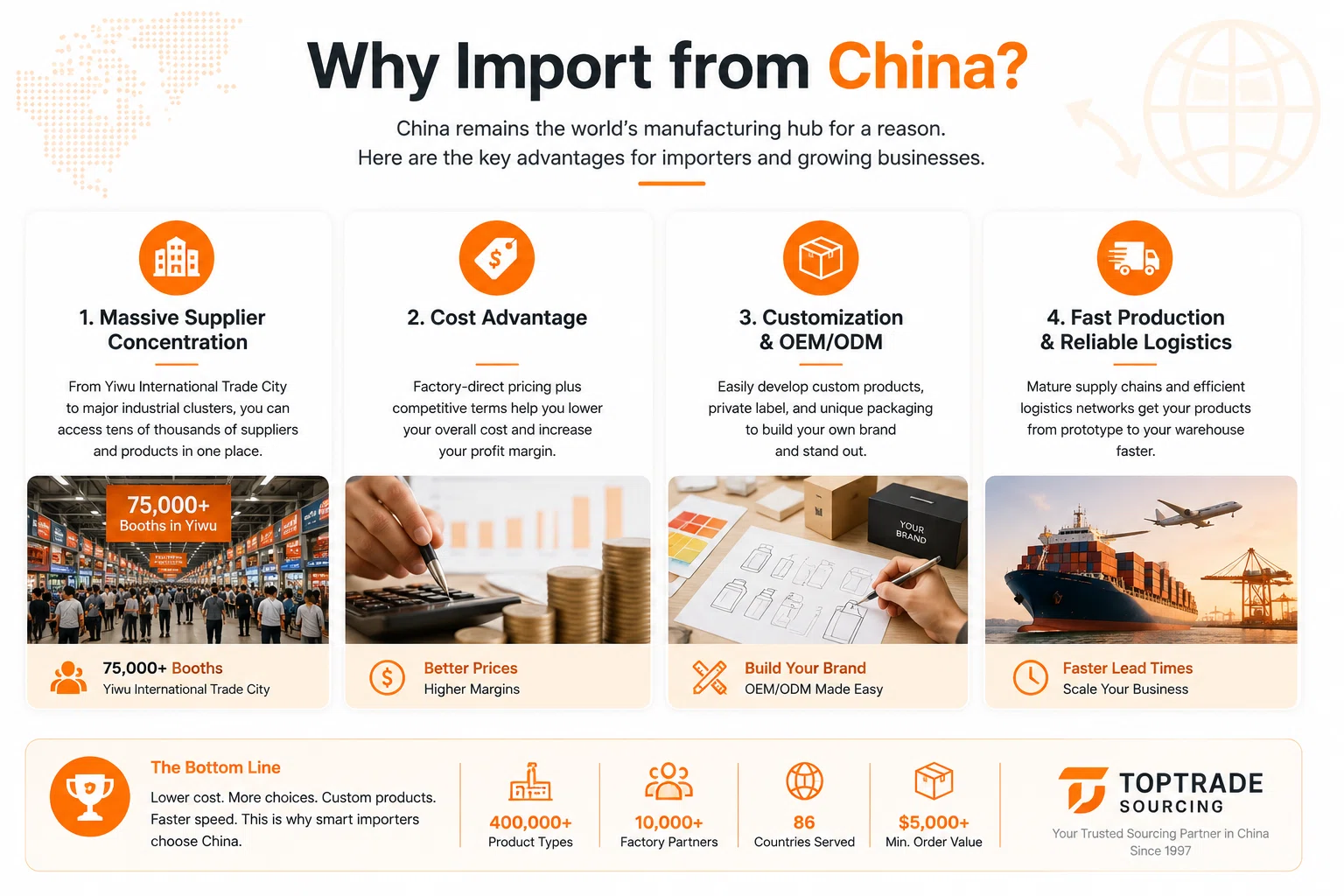
China remains the world’s manufacturing hub for a reason: unmatched supplier density, mature logistics, and the ability to scale from prototype to container within weeks. For a first-time buyer, the appeal is simple:
- Supplier concentration — One trip to Yiwu International Trade City puts you in front of 75,000+ booths; a single China sourcing agent can shortlist vetted factories across categories.
- Cost structure — Factory-direct pricing plus negotiated terms typically beats domestic wholesale, even after freight and duties.
- Customization — OEM/ODM development lets you launch a private-label product, not just resell a commodity.
- Speed to market — Short lead times and consolidated shipping get inventory moving fast.
The catch: the savings only materialize if you control quality and compliance. The steps below show you how.
Step 1 — Research Your Product and Validate Demand
Before you contact a single factory, confirm the product is worth importing.
- Define the spec — Material, size, function, certifications (CE, FCC, FDA, etc.), and packaging requirements.
- Check demand and competition — Use Amazon Best Sellers, Google Trends, and your own sales data.
- Estimate landed cost early — Unit price + freight + duties + agent fee. If the math doesn’t beat your local wholesale price by a healthy margin, stop here.
- Confirm importability — Some goods (certain electronics, food, textiles) carry strict rules. The U.S. Customs and Border Protection basic import/export guide is the authoritative starting point for U.S. buyers.
First-time mistake: falling in love with a product before checking whether it can clear customs legally in your market.
Step 2 — Understand Import Rules, Duties, and Licenses
You generally do not need a special license to import most consumer goods for resale — but you do need a registered importer number (an IRS EIN works in the U.S.) and you must pay the correct duty.
- Classify your product with an HTS code — The HTS lookup tool from the U.S. International Trade Commission tells you the tariff rate. Duty is calculated on customs value, not just product cost.
- Know your landed cost — Duty + Merchandise Processing Fee + freight + insurance. The International Trade Administration’s importing overview breaks down the U.S. process end to end.
- Mind restricted and regulated goods — Textiles, toys (CPSIA), cosmetics, and electronics each have compliance layers.
Getting this right up front prevents costly holds at the border later.
Step 3 — Find and Vet Reliable Suppliers
This is where most first-time buyers either win or lose. You have three main channels:
| Channel | Best for | Watch-outs |
|---|---|---|
| Online marketplaces (e.g. Alibaba.com) | Quick supplier discovery, small MOQs | Verify every supplier; gold badges ≠ vetting |
| Trade shows (e.g. the Canton Fair) | Meeting factories face-to-face, OEM/ODM | Travel cost; need a plan |
| Sourcing hubs (Yiwu, Guangzhou, Ningbo) | Depth of suppliers, negotiation | Language and logistics overhead |
A Yiwu market agent gives you on-the-ground supplier research across 75,000+ booths and 10,000+ factory partners without flying in blind. If you prefer to meet factories at China’s largest trade event, a Canton Fair agent handles navigation, interpretation, and follow-up.
Vetting checklist:
- Request business license and factory audit (a good agent does this for you).
- Ask for references and verifiable export history.
- Start with a small trial order before committing to a full container.
Step 4 — Request Samples and Negotiate
Never skip samples. A sample confirms material, workmanship, and that the factory understood your spec.
- Order 2–3 samples from shortlisted suppliers and compare.
- Negotiate on unit price, MOQ, lead time, and payment terms — not price alone.
- Standard terms for new relationships: 30% deposit, 70% against bill of lading or after inspection.
If you’re building a brand, this is also the moment for OEM/ODM design and packaging — custom logos, retail-ready packaging, and barcode/label compliance handled by an in-house design team (Toptrade runs 80+ designers).
Step 5 — Master Incoterms Before You Agree on Price
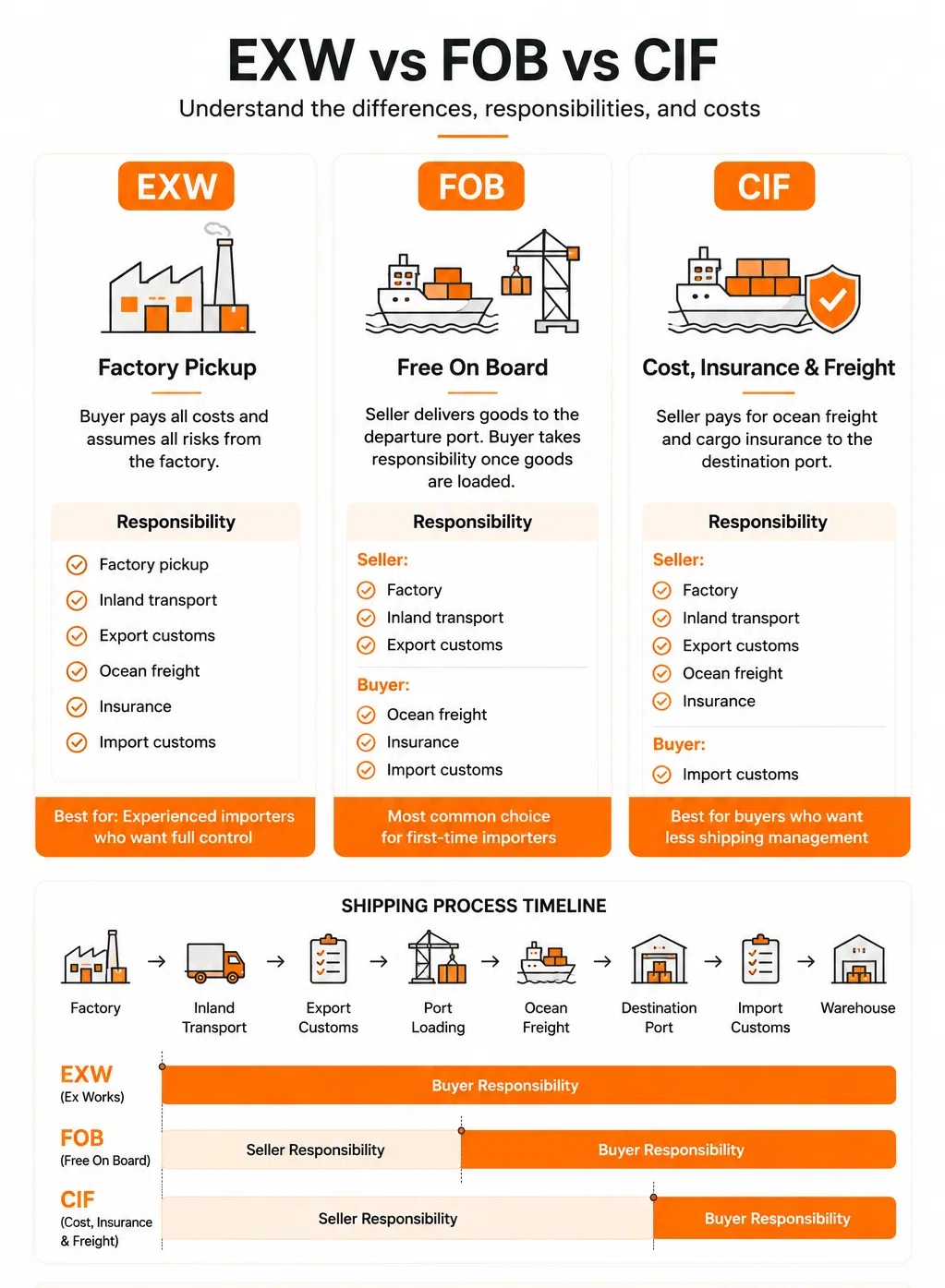
The price you’re quoted is meaningless without knowing who pays for what. Incoterms (published by the International Chamber of Commerce) define responsibility for freight, insurance, and risk transfer.
Common ones for China imports:
- EXW (Ex Works) — You own everything from the factory door. Cheapest quote, most responsibility.
- FOB (Free On Board) — Seller delivers to the port of origin; you handle ocean freight and beyond. Most common for first-timers.
- CIF (Cost, Insurance, Freight) — Seller covers to your destination port. Convenient, but you pay a margin.
Understanding Incoterms lets you compare quotes apples-to-apples and avoid surprise costs at delivery.
Step 6 — Inspect Quality and Monitor Production
The biggest risk in importing from China isn’t the factory disappearing — it’s a container of defects arriving at your warehouse.
- Pre-shipment inspection (PSI) against an AQL standard (AQL 2.5 is a common default) catches issues before they ship.
- A China sourcing agent coordinates factory audits, sample confirmation, and production monitoring with weekly progress reports.
- Build a clear QC checklist: function, appearance, packaging, labeling, and count.
Toptrade’s model includes factory audit and pre-shipment quality inspection as standard — the 80% repeat-order rate among its 10,000+ clients is what disciplined QC buys you.
Step 7 — Arrange Shipping, Logistics, and Warehousing
Once inspected, your goods need to move. Options:
- Express courier (DHL/FedEx) — samples and small parcels; fast, pricey per kilo.
- Air freight — urgent, mid-volume.
- Sea freight (FCL/LCL) — the default for wholesale; cheapest per unit, slowest.
A logistics and warehousing partner consolidates multiple suppliers into one shipment, stores goods in a China warehouse, and books the container out of Yiwu or Ningbo. Consolidation is where a lot of first-time savings come from — one customs entry, one bill of lading, one delivery.
Rule of thumb: ocean transit from China to the U.S. West Coast runs roughly 15–25 days; add a week or more for the East Coast and customs clearance.
Step 8 — Clear Customs, Insure, and Settle Payment
At the border, you (or your freight forwarder/broker) file entry, pay duty, and release the cargo.
- Use a licensed customs broker for your first shipments.
- Keep commercial invoice, packing list, and HTS classification consistent — mismatches trigger holds.
- Insure the shipment. Import insurance and trade finance options protect against loss, damage, and non-payment risk on larger orders.
For buyers placing $50,000+ orders, backing from a parent group (Toptrade sits under Sellers Union Group, a $1B-revenue Yiwu trading group with 1,000+ employees) can mean accounts-receivable insurance and multi-currency escrow — protections a solo agent can’t offer.
Step 9 — Receive, Sell, and Scale
Goods arrived, inspected, and on your shelf? Now the real business starts.
- Reconcile the shipment against the packing list immediately.
- Feed sales data back into Step 1 — double down on winners, drop laggards.
- Build a repeat-order rhythm with your best factory.
If you supply retail chains, a supermarket supply program handles the breadth of SKUs, private-label packaging, and the consistency supermarket buyers demand.
Why First-Time Buyers Work With a China Sourcing Agent
Everything above is doable solo — but the learning curve is steep and the cost of a mistake (a defective container, a customs hold, a vanished deposit) is high. That’s the commercial case for a China sourcing agent:
- Lower cost — Toptrade’s commission starts at 3% vs. an industry norm of 5–15%.
- Risk control — Supplier vetting, factory audits, and pre-shipment inspection built in.
- One throat to choke — Sourcing, design, QC, logistics, and insurance under one roof since 1997.
- Local presence — A 1,200㎡ Yiwu showroom (plus a 10,000㎡ VR showroom you can tour from a browser) and 3,000+ buyer visits a year.
You can visit the VR showroom or contact our team for a sourcing plan within 3–5 business days.
Frequently Asked Questions
How much does it cost to import from China?
Beyond the product price, budget for freight (sea freight is cheapest per unit), import duty based on your HTS code, broker fees, and optionally an agent commission. Many first-time buyers are surprised that duty + freight can equal 20–40% of product cost, so calculate landed cost before ordering.
Do I need a license to import from China?
For most consumer goods, no special import license is required — you need an importer number (an EIN in the U.S.) and must comply with product-specific regulations. Restricted categories (food, certain electronics, textiles, toys) have extra compliance steps. The CBP import guide covers the U.S. baseline.
What is the cheapest way to import from China?
Ocean freight (FCL for full containers, LCL for shared) is the cheapest per unit. Consolidating multiple suppliers into one shipment and using FOB Incoterms keeps costs predictable. Express and air freight cost far more and only make sense for samples or urgent restocks.
How long does shipping from China take?
Ocean freight runs roughly 15–25 days to the U.S. West Coast, longer to the East Coast, plus production and customs time. Air freight is 3–7 days but multiples the cost. Build lead time into your reorder point.
Is it safe to import from China for the first time?
Yes, with the right controls: vet the factory, order samples, use secure payment terms (deposit + balance after inspection), and insure the shipment. Working with an established agent with a track record since 1997 and an 80% repeat-order rate materially de-risks a first order.
Start Your First Import With a Plan
Learning how to import from China is really learning a repeatable system: research, vet, sample, inspect, ship, clear, scale. Do it once well and you have a supply chain you can run for years.
Ready to skip the trial-and-error? Get a free sourcing quote and we’ll return a shortlist of vetted suppliers, a quote, and sample options within 3–5 business days.
Toptrade Sourcing — a Yiwu-based China sourcing agent since 1997, backed by Sellers Union Group. Serving retailers, wholesalers, e-commerce sellers, and supermarket chains in 86 countries.

我负责网站的日常运营和内容管理。我的工作重点是优化用户体验、提升网站性能,并确保客户能够轻松找到所需的产品和服务。我与采购和客户服务团队紧密合作,确保网站内容及时更新,提供可靠的信息、清晰的产品详情和实用的资源。我的目标是使我们的平台不仅成为一个商业工具,更成为国际买家的宝贵指南。