

Sourcing from China remains the default growth lever for Amazon FBA sellers in 2026 — but the playbook has changed. Longer lead times, stricter compliance checks, and rising freight volatility mean the sellers who win are the ones who treat sourcing as a system, not a one-off Alibaba order. This guide walks through the full path: picking a product, finding and vetting a factory, private labeling, inspection, FBA prep, and shipping — with the exact checkpoints a Yiwu-based agent uses for FBA clients every week.
Why source from China for Amazon FBA?
China still offers the widest supplier base on earth — from the 75,000+ booths of Yiwu International Trade City to factory-direct networks across Guangdong and Zhejiang. For FBA sellers the advantages are concrete:
- Unit economics: Lower ex-factory cost lets you protect margin after Amazon’s referral and FBA fees.
- Private label depth: OEM/ODM ecosystems make branding and customization fast and affordable.
- Assortment speed: You can test multiple SKUs and reorder in weeks, not months.
The honest trade-offs are lead time, communication, and compliance. Those are exactly the risks a structured sourcing process — or a sourcing agent — is built to absorb.
Step 1 — Pick the right product (with FBA fees in mind)
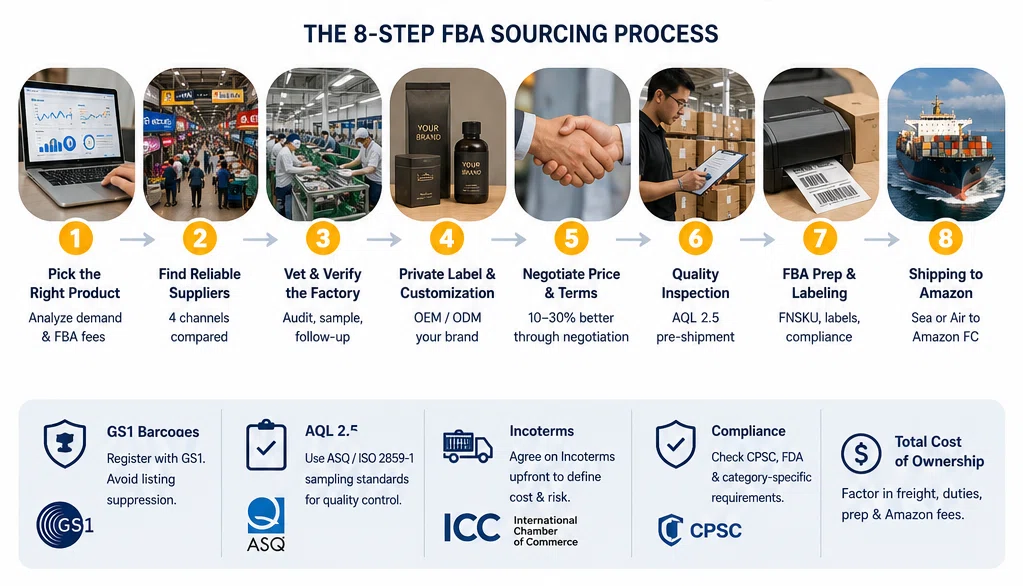
Before you contact a single factory, model the numbers. Use the Amazon selling tools and Seller Central fee calculator to estimate referral fees, FBA fulfillment, and storage. A product only works if the landed cost (factory price + freight + duties + prep) leaves room after Amazon takes its cut.
Screen before you source: Avoid gated or restricted categories. Check Amazon’s Seller Central restricted-products policy early — compliance surprises after production are the most expensive mistakes in this business.
Good FBA candidates for 2026 tend to share three traits: small/light (lower FBA weight fees), non-fragile, and differentiable through branding or a small design tweak.
Step 2 — Find reliable suppliers (4 channels compared)
You have four realistic channels to find a factory. Each has a different risk/reward profile:
| Channel | Best for | Risk | Tip |
|---|---|---|---|
| Alibaba.com | First orders, verified suppliers | Middlemen mixed with factories | Filter “Trade Assurance” + “Verified” + “Gold Supplier” |
| Yiwu Market (offline + online) | Assortment, low-MOQ, mixed containers | Navigating 75,000+ booths | Use a Yiwu agent to shortlist |
| Canton Fair | Meeting factories face-to-face | High MOQs, travel cost | See our Canton Fair guide |
| Sourcing agent network | Vetting, negotiation, QC | Commission cost | Transparent from ~3% — see our cost breakdown |
Step 3 — Vet & verify the factory
Never skip verification. A structured vetting sequence protects you from scams and quality drift:
- RFQ to 5–8 suppliers with the same spec sheet so quotes are comparable.
- Sample order — judge build quality, not just price.
- Factory audit — confirm they make what they claim (a third-party or agent visit).
- Production follow-up — photos at 30/60/90% completion.
For barcodes and brand identity, register with GS1 so your UPCs are authentic (Amazon cross-checks GS1 databases). Counterfeit barcodes get listings suppressed.
Step 4 — Private label & OEM/ODM customization
Private label is where margin lives. Work with a partner that has in-house design — our design & packaging team (80+ designers) turns a generic item into a branded SKU with custom packaging, inserts, and logos. Two models:
- OEM: You provide the design/spec; the factory produces to it.
- ODM: The factory’s existing design is adapted and branded for you.
Lower your effective MOQ by consolidating several SKUs into one shipment — a core strength of a Yiwu agent.
Step 5 — Negotiate price & terms
Negotiation in Mandarin, with volume context, routinely beats a buyer’s first quote by 10–30%. Build in transparent agent fees (our commission breakdown shows the math vs. 5–15% industry norms) and agree on Incoterms upfront — see the ICC Incoterms rules for who owns freight and risk at each handoff.
Step 6 — Quality inspection before shipment (AQL)
A pre-shipment inspection using AQL (Acceptance Quality Limit) is non-negotiable for FBA. The most common retail standard is AQL 2.5 for major defects. Sampling methods follow the ASQ acceptance-sampling standard (ISO 2859-1). Catch defects in China — returns and disposals at an Amazon FC are far costlier.
Step 7 — FBA prep, labeling & packaging compliance
- FNSKU labels on every unit (barcode scannable, no overlap with retail UPC).
- Poly bag > 5″ opening needs a suffocation-warning label.
- Box rules: Six-sided, no string/tape protrusions, 50 lb max for standard-size.
- Compliance: Check CPSC for children’s products, toys, and textiles; certain categories need FDA or third-party testing.
Many FBA sellers have their agent do labeling and inspection in China so goods arrive FBA-ready — fewer delays at the dock.
Step 8 — Shipping & logistics to Amazon
Choose sea (cheapest, 30–45 days) vs. air (fast, pricey) based on reorder velocity. A freight and warehousing partner can consolidate multiple suppliers into one container, prep documents, and ship DDP to a指定 Amazon FC. Confirm Incoterms so you know exactly where cost and risk transfer.
Mistakes to avoid
- Skipping the sample stage to save a few dollars.
- Using non-GS1 barcodes (listing suppression risk).
- Ignoring compliance for toys/electronics/textiles.
- Booking freight without confirming FBA prep requirements.
- Single-supplier dependency — always keep a backup factory.
Why use a sourcing agent for FBA
A sourcing agent compresses the whole playbook into one accountable partner: supplier shortlisting, Mandarin negotiation, factory audit, AQL inspection, private-label design, and consolidated shipping. Backed by Sellers Union Group ($1B revenue, since 1997), Toptrade serves FBA and Shopify sellers from a 1,200㎡ Yiwu showroom plus a 10,000㎡ VR showroom you can tour before committing.
Frequently asked questions
Is it cheaper to use a sourcing agent than sourcing from China myself?
For most FBA sellers, a sourcing agent reduces total cost of ownership: better factory pricing through volume negotiation, fewer quality defects, and consolidated shipping.
What is the typical MOQ when sourcing from China for Amazon FBA?
MOQs vary by category and customization. Stock items can start around 100–500 units; custom private label usually starts at 500–1,000 units per SKU. A Yiwu agent can often combine orders to lower effective MOQs.
Do I need a barcode (UPC/EAN) for Amazon FBA?
Yes. Every sellable unit needs a scannable barcode. Amazon requires GS1-issued UPCs (or Amazon’s own barcode, FNSKU, applied during FBA prep) so products can be received and tracked in fulfillment centers.
Ready to source your next FBA product from China?
Send your product brief and get a vetted supplier shortlist + quote in 3–5 business days.

我负责网站的日常运营和内容管理。我的工作重点是优化用户体验、提升网站性能,并确保客户能够轻松找到所需的产品和服务。我与采购和客户服务团队紧密合作,确保网站内容及时更新,提供可靠的信息、清晰的产品详情和实用的资源。我的目标是使我们的平台不仅成为一个商业工具,更成为国际买家的宝贵指南。