



1. Why Toy Safety Certifications Matter in Global Trade
Toy safety certifications are often treated as a formality in international sourcing. In reality, they directly determine whether your products can move, sell, and survive in your target market. For global toy buyers, certification issues rarely show up as small problems. They usually appear as expensive and time-consuming consequences.
Customs clearance delays are one of the most common outcomes. When a shipment arrives without valid or complete safety documentation, customs authorities may hold the goods for additional review or testing. This can delay delivery for weeks, disrupt seasonal sales plans, and create unexpected storage and inspection costs. In some cases, shipments are returned or destroyed before they ever reach the warehouse.
Amazon and major retailers apply stricter rules than customs. Even if a shipment clears import inspection, platforms like Amazon or large retail chains can still reject products that do not meet their internal compliance requirements. Missing ASTM, EN71, or CPSIA documentation often leads to listing removal, blocked inventory, or permanent supplier disqualification. Once a compliance record is flagged, restoring trust with the platform becomes extremely difficult.
Product recalls and brand damage carry long-term risks. Safety failures discovered after products reach the market can trigger recalls, customer complaints, and public safety notices. For brands and importers, this does not only mean direct financial loss. It can damage reputation, reduce buyer confidence, and limit future cooperation with distributors and retailers.
Insurance and liability risks are often overlooked. Many product liability insurance policies require proof of compliance with relevant toy safety standards. Without valid certifications, claims may be denied in the event of accidents or injuries. In serious cases, importers and brand owners can face legal responsibility for non-compliant products, even if manufacturing was outsourced.
Toy safety certification is not paperwork. It is risk control.
For global buyers, proper certification protects cash flow, market access, and brand credibility long before products reach the shelves.
2. EN71 Explained – Toy Safety Standard for the EU Market
2.1 What Is EN71 Certification?
EN71 is the core toy safety standard under the European Union Toy Safety Directive. It defines whether a toy is safe for children and legally acceptable in the EU and UK markets. For importers and brand owners, EN71 compliance is not optional. It determines whether products can pass customs checks, enter retail channels, and remain on sale without compliance risks.
EN71 applies to almost all toys intended for children under 14 years old, regardless of whether they are sold online, in physical stores, or through large retail chains. Even simple or low-cost toys are subject to EN71 requirements if they are classified as children’s products.
2.2 What Tests Are Included in EN71?
EN71 is not a single test. It is a group of safety assessments that focus on different risk areas. Among all parts, buyers should pay particular attention to the following four, as they are the most frequently checked and the most likely to cause compliance failures.
EN71 Part 1 – Mechanical and Physical Properties
This part evaluates structural safety. It focuses on small parts, sharp edges, points, and mechanical strength. Toys that break easily or contain detachable components can fail this test, especially products designed for younger children.
EN71 Part 2 – Flammability
This test measures how easily a toy can catch fire and how fast flames spread. Plush toys, fabric-based products, and costumes are commonly affected. Non-compliant materials or untreated fabrics often lead to failure in this section.
EN71 Part 3 – Migration of Certain Elements
Part 3 controls the migration of heavy metals and harmful elements from toy materials. Painted surfaces, coatings, and colored plastics are high-risk areas. This is the most widely known EN71 test, but it is also the most misunderstood.
EN71 Part 9–11 – Organic Chemical Compounds
These parts focus on organic chemical substances such as certain solvents, plasticizers, and additives. Toys made from soft plastics, rubber, or complex composite materials face higher risks under these requirements.

2.3 Which Toys Are Most Likely to Face EN71 Issues?
Some toy categories face higher failure rates due to their structure or materials. Small-part toys are particularly risky because detachable components can create choking hazards. Painted toys often fail due to heavy metal migration or coating quality issues. Plush toys face flammability and material consistency risks. DIY and educational toys, which usually combine multiple materials and functions, often fail because changes in one component affect the overall compliance result.
2.4 Common EN71 Mistakes Buyers Make
One common mistake is testing only EN71 Part 3 and assuming the toy is fully compliant. While Part 3 is important, it does not cover mechanical safety or flammability risks. Another frequent issue is using outdated test reports that no longer match current production materials or standards. The most serious risk occurs when the tested sample does not match the actual bulk shipment, due to material substitution or design changes during mass production.
For EU and UK toy buyers, EN71 compliance must be treated as a process, not a one-time test. Without proper control between sampling, testing, and mass production, certification quickly loses its value.
3. ASTM F963: Toy Safety Standard for the U.S. Market
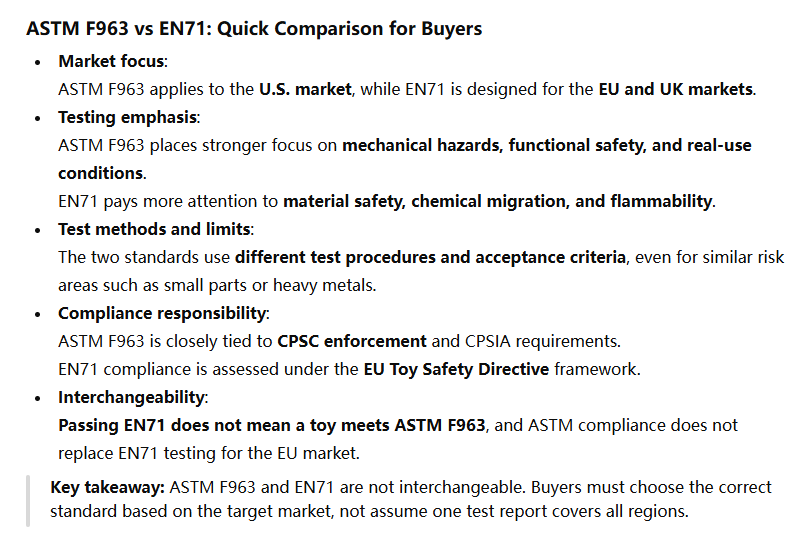
ASTM F963 is the mandatory toy safety standard for the United States market. It is officially recognized and enforced by the Consumer Product Safety Commission (CPSC), which means compliance is not optional for toys sold in the U.S. Whether products are sold through Amazon, retail chains, or private brands, ASTM F963 compliance is a basic market entry requirement.
Unlike some regional standards that focus mainly on materials or chemical limits, ASTM F963 places strong emphasis on how toys behave during real use. Many compliance failures in the U.S. market are not caused by material issues alone, but by mechanical design, functional structure, or unexpected hazards during play.
Key Tests Covered by ASTM F963
Mechanical Hazards
ASTM F963 evaluates whether toys can break, detach, or deform under normal or foreseeable use. Components that become loose, crack, or separate can create choking, cutting, or injury risks. Moving parts and assembled structures are frequent failure points.
Sharp Points and Edges
This test checks whether a toy contains exposed sharp points or edges that could cause cuts or puncture injuries. Even small structural changes in production can result in failure, especially for plastic or metal toys with molded or stamped parts.
Heavy Metals and Material Safety
ASTM F963 includes limits on heavy metals in accessible components. Painted toys, coatings, inks, and surface treatments are common risk areas. Non-compliant pigments or inconsistent coatings can lead to test failure, even if the base material itself is safe.
Electrical and Sound-Related Safety (If Applicable)
For electronic toys, ASTM F963 also evaluates electrical safety, battery compartments, wiring, and sound pressure levels. Toys with lights, sounds, or electronic functions face higher compliance complexity and higher inspection failure rates.
4. CPSIA Compliance: What Buyers Often Miss
The Consumer Product Safety Improvement Act (CPSIA) is the foundation of toy safety compliance in the United States. Many buyers assume CPSIA is simply another lab test requirement. In reality, CPSIA is a compliance system, not a single report. It defines who is responsible, what must be documented, and how toy safety is verified throughout the supply chain.
For U.S. imports, passing a lab test alone does not equal CPSIA compliance. When enforcement actions occur, U.S. authorities focus less on whether a factory tested the product and more on whether the importer or brand owner can legally prove compliance.
4.1 The Three Core CPSIA Requirements Buyers Must Meet
ASTM F963 Compliance
CPSIA requires children’s toys sold in the U.S. to comply with ASTM F963. This standard covers mechanical safety, material risks, and functional hazards. ASTM F963 testing is the technical foundation, but it is only one part of the CPSIA framework.
Lead and Phthalates Limits
CPSIA sets strict limits on lead content and certain phthalates in accessible components. These limits apply not only to finished toys, but also to coatings, paints, plastics, and internal parts that children can access during normal use or foreseeable abuse. Material substitution during production is a common reason for CPSIA failure.
CPC (Children’s Product Certificate)
The CPC is a legally required document that certifies a children’s product complies with all applicable U.S. safety rules. It must reference the correct product, applicable standards, and valid test reports from accredited laboratories. Without a proper CPC, a toy is considered non-compliant, even if testing was completed.
4.2 Who Is Responsible for the CPC?
This is where many buyers make critical mistakes. The CPC is the responsibility of the importer or brand owner, not the factory. While manufacturers may assist by providing test reports or technical data, they cannot legally assume compliance responsibility on behalf of the importer.
Relying on a factory to “prepare a CPC” without proper verification exposes buyers to serious risk. If a product is inspected, recalled, or involved in a safety incident, authorities will hold the U.S. importer or brand owner accountable, regardless of where the toy was manufactured.
CPSIA compliance is not something that can be outsourced completely. For U.S. toy buyers, it requires clear documentation, verified test reports, and controlled production processes. Without these elements in place, even a fully tested toy can still fail compliance review.
5. EN71 vs ASTM vs CPSIA – Quick Comparison for Buyers
| Item | EN71 | ASTM F963 | CPSIA |
| Target Market | EU / UK | USA | USA |
| Mandatory | Yes | Yes | Yes |
| Covers Mechanical Safety | ✔ | ✔ | ✔ |
| Chemical Restrictions | ✔ | ✔ | ✔ |
| Requires CPC | ✖ | ✖ | ✔ |
| Toy Safety Testing Standard | ✔ | ✔ | ✖ |
| Federal Compliance Law | ✖ | ✖ | ✔ |
| Lead & Phthalates Limits | ✔ | ✔ | ✔ |
| Can Replace Other Standards | ✖ | ✖ | ✖ |
| Importer Responsibility | Medium | Medium | High |
Choosing the wrong standard is one of the most common sourcing mistakes.
6. Sample ≠ Mass Production
One of the most overlooked risks in toy sourcing is assuming that a lab-tested sample represents mass production. In practice, many compliance failures occur not because testing was skipped, but because the tested sample no longer matches the bulk goods.
Lab-tested samples do not always reflect bulk production.
Samples are often produced with extra care, selected materials, or even different workshops. Once production scales up, factories may adjust materials, processes, or suppliers to control cost and speed. These small changes can silently invalidate a test report.
Material substitution is a common hidden risk.
Plastic grades, fillers, fabrics, or internal components may be replaced without formal notice. While the toy looks the same, its chemical composition or mechanical behavior can change, leading to failures in EN71, ASTM F963, or CPSIA testing.
Paint and coating inconsistency creates compliance gaps.
Painted toys are especially sensitive. Differences in pigments, coating thickness, or curing processes can cause heavy metal migration or durability failures. A coating that passes testing on a sample may fail once applied across thousands of units.
Small structural changes can cause test failure.
Minor design adjustments, such as thinner walls, looser joints, or altered assembly methods, can affect mechanical strength. These changes often trigger failures in small parts, sharp edges, or tension and torque tests, even though the toy appears unchanged.
7. How to Make Sure Your Toy Certifications Are Valid
Valid toy certification is not just about having documents on file. It is about making sure those documents can stand up to checks from customs, platforms, and regulators. Buyers can reduce compliance risks by following these steps before shipment.
Step 1: Match the Test Report to the Exact Product
Start by confirming that the test report clearly matches the toy you are importing. The model number, materials, structure, and intended age group should be consistent with the bulk goods. If photos or descriptions are vague or generic, the certification may not apply to your actual shipment.
Step 2: Verify the Testing Laboratory’s Accreditation
Check whether the test report was issued by an ISO/IEC 17025–accredited laboratory that is recognized in your target market. Reports from unaccredited or unknown labs may be rejected by customs authorities or selling platforms, even if the test results look complete.
Step 3: Confirm the Report Is Current and Relevant
Toy safety standards change, and production details evolve over time. Make sure the report is still within a reasonable validity period and reflects the current materials and design. Outdated reports are a common reason for compliance disputes.
Step 4: Check Market-Specific Coverage
Ensure the certification covers the correct market. EN71 reports apply to the EU and UK. ASTM F963 and CPSIA apply to the U.S. market. Using the wrong standard, even with a valid report, can lead to shipment delays or listing rejection.
Step 5: Verify Consistency Between Testing and Production
Certification only works if production matches the tested sample. Review material confirmations, inspection records, and production photos to ensure no substitutions or structural changes occurred after testing. Supporting documentation often determines whether a certification is accepted during review.
Following these steps helps buyers turn test reports into real compliance protection, not just paperwork. Certification is effective only when testing, production, and inspection are aligned throughout the sourcing process.
Conclusion
Toy safety certifications are not a one-time requirement or a document to collect at the end of sourcing. They are part of a risk management process that starts with product design and continues through testing, production, and shipment.
EN71, ASTM F963, and CPSIA each serve a different purpose. Using the wrong standard, relying on outdated reports, or assuming samples represent mass production can expose buyers to customs delays, platform rejection, recalls, and legal liability. These risks increase when certification is treated as paperwork instead of an integrated compliance system.
For global toy buyers, the goal is not simply to pass a test, but to ensure that what was tested is exactly what gets shipped. When certification, inspection, and production control work together, compliance becomes predictable and manageable rather than reactive and costly.
If you are sourcing toys from China and want to reduce compliance risks, our team supports buyers with supplier verification, toy safety testing coordination, and on-site quality inspection before shipment. We help ensure that certified samples, mass production, and final deliveries remain consistent.

I am responsible for the daily operation and content management of our website. My work focuses on optimizing user experience, improving website performance, and ensuring that customers can easily find the products and services they need. I collaborate with our sourcing and customer service teams to keep the site updated with reliable information, clear product details, and helpful resources. I aim to make our platform not only a business tool but also a valuable guide for international buyers.