



Introduction
In the wholesale home decor business, design alone is never enough. Behind every vase, wall art piece, or decorative tray, the material determines the real value of the product. It affects cost, durability, shipping safety, compliance, and ultimately your profit margin.
Many B2B buyers focus heavily on style and trend. However, experienced importers understand that material selection plays a much bigger role in long-term success. The same home decor design can vary greatly in price and market positioning depending on whether it is made from wood, resin, ceramic, metal, or glass.
If you are sourcing wholesale home decor from China or other Asian markets, understanding materials is not optional. It is a key step in reducing risk, controlling quality, and protecting your brand reputation.
In this guide, we will explain the most common home decor materials and what B2B buyers should pay attention to before placing bulk orders.
1. Why Material Selection Matters in Home Decor Business
In the home decor industry, material choice is not just a production decision. It is a business decision. For B2B buyers, material directly influences pricing strategy, order planning, logistics cost, compliance risk, and retail positioning.
• Pricing structure
First, material determines the pricing structure. The same design can have very different factory costs depending on whether it is made from resin, ceramic, MDF, or solid wood. Resin may require mold investment but allows efficient mass production. Ceramics often involve a higher breakage risk and a heavier shipping weight. Solid wood requires stricter raw material control and higher labor cost. When you compare supplier quotations, you are not only comparing design. You are comparing material systems behind that design.
• MOQ differences
Second, MOQ differences often come from material type. For example, resin products usually require mold-based production, which may increase the initial order quantity to absorb the tooling cost. Ceramic factories may set MOQ based on kiln capacity. MDF or metal workshops may allow more flexible quantities depending on production scheduling. Understanding this helps buyers negotiate better and plan inventory more accurately.
• Breakage rate during shipping
Third, the breakage rate during shipping is closely linked to the material. Ceramic and glass items increase packaging cost and container weight. Higher damage rates reduce real profit margin. On the other hand, MDF or resin products are generally more stable during sea freight. If your business relies on long-distance export, this factor directly affects the total landed cost.
• Certification requirements
Certification and compliance requirements also vary by material. Some markets require chemical compliance testing for surface coatings, especially for resin and painted products. Wooden products may require fumigation documentation. Metal items need proper surface treatment to prevent rust complaints. These factors influence both cost and timeline.
• Retail positioning
Finally, material defines retail positioning. MDF with PVC coating may target entry-level mass retail. Solid wood with hand-finishing can support a premium lifestyle brand. Resin allows detailed artistic designs suitable for seasonal or decorative collections. The same design made in resin, ceramic, or MDF can have completely different cost structures and market positioning. That difference shapes your target customer and pricing strategy.
For professional B2B buyers, material selection is not about preference. It is about margin control, risk management, and brand strategy.
2. Common Materials Used in Wholesale Home Decor
Different materials create different cost structures, risk levels, and retail positioning. For wholesale buyers, understanding these differences helps reduce sourcing mistakes and improve profit planning.
2.1 Wood & MDF
Wood remains one of the most widely used materials in wholesale home decor. It delivers a natural aesthetic that fits both modern and classic retail styles. However, buyers must clearly distinguish between solid wood and engineered wood such as MDF.
Products include: wall frames, shelves, small furniture pieces.
Solid wood supports higher-end positioning due to its natural texture and durability. MDF is more cost-efficient and widely used in mass-market collections because it offers structural stability and smooth surfaces for coating or painting.
Advantages
Wood products offer strong visual warmth and allow flexible customization. They are suitable for mid-range and premium retailers that emphasize lifestyle branding.
Limitations and Risks
Moisture sensitivity is the main concern. Poor drying processes can lead to warping or cracking during long sea shipments. Surface paint cracking may occur if the base material is unstable. Packaging must remain dry, and factory humidity control should be verified before production.Some buyers may request FSC-related documentation to support sustainability positioning, especially in European markets.
2.2 Ceramic & Porcelain
Ceramic and porcelain are commonly used in decorative home collections due to their premium appearance and strong perceived value.
Products include: vases, decorative bowls, candle holders.
These materials create a heavier and more substantial feel, which supports higher retail pricing. They are often chosen by boutique stores and gift-focused retailers.
Advantages
High-end visual appeal and strong decorative impact. Ceramic products often photograph well and enhance shelf presentation.
Limitations and Risks
Breakage rate is the primary concern. Ceramic is fragile, and improper packaging directly reduces real profit margin. In addition, heavier weight increases total shipping cost, especially for export markets.For B2B buyers, packaging strategy is as important as material selection itself. Reinforced cartons, inner protection, and drop testing should be confirmed before shipment.
2.3 Resin (Polyresin)
Resin is extremely common in wholesale home decor because of its flexibility and production efficiency. It allows detailed shapes and creative designs that are difficult to achieve with other materials.
Products include: figurines, statues, seasonal decorations.
Compared with ceramic, resin usually offers lower tooling investment and easier mass production control. Its lighter weight also reduces shipping cost.
Advantages
Flexible mold design, strong detail capability, and cost efficiency for medium to large orders.
Limitations and Risks
Surface finishing quality must be closely monitored. Paint adhesion problems, uneven coating, or color variation may appear in bulk production. Low-grade materials may also produce unwanted odor.In certain markets, coating compliance requirements such as REACH or CA65 may apply. Early clarification helps avoid regulatory risk.
Resin supports creativity and scalability, but finishing control determines final quality perception.
2.4 Metal (Iron, Aluminum)
Metal decor products are popular in modern and industrial-style collections. Iron and aluminum are frequently used for wall decor and artistic display pieces.
Products include: wall art, candle holders, modern decorative frames.
Metal provides strong structural support and a contemporary aesthetic that suits mid-range retail positioning.
Advantages
Durability, stable structure, and strong design appeal.
Limitations and Risks
Surface treatment is the key risk factor. Without proper anti-rust protection, iron products may corrode during shipping or storage. Powder coating quality must be consistent to avoid peeling or color difference. Edge finishing also requires attention for safety reasons.Metal decor should pass basic surface treatment inspection before shipment to reduce after-sale complaints.
2.5 Glass & Acrylic
Glass and acrylic materials are commonly used in modern display-oriented decor products. They provide a clean and minimalist visual effect.
Products include: mirrors, table decor, display pieces.
These materials help elevate perceived product value and fit contemporary interior trends.
Limitations and Risks
Fragility is the main concern for glass. Thickness control and reinforced packaging are critical. Acrylic is lighter but prone to surface scratches if protective film is not properly applied.For these materials, logistics planning must be integrated into the sourcing decision from the beginning.
Material Comparison Overview
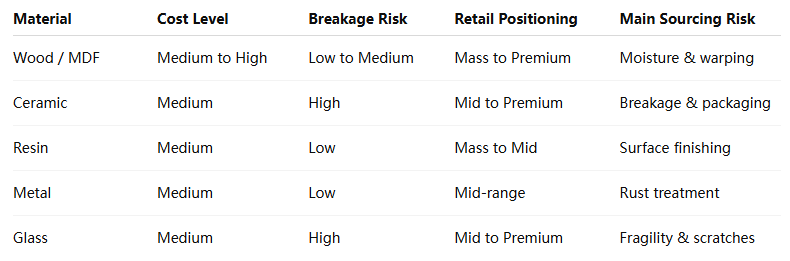
Below is a simplified comparison for wholesale buyers:
This structured evaluation helps buyers understand that material selection is not a simple design choice. It directly affects cost control, shipping safety, compliance exposure, and retail positioning.
The same design made in resin, ceramic, or MDF can lead to completely different profit margins and market strategies.
3. Material vs Market Positioning
In the wholesale home decor business, material is not only a cost factor. It directly defines your target customer and retail channel. The same design can be positioned in completely different markets depending on the material combination and finishing level.
Professional B2B buyers do not select materials randomly. They align material choice with pricing strategy, brand identity, and customer expectations.
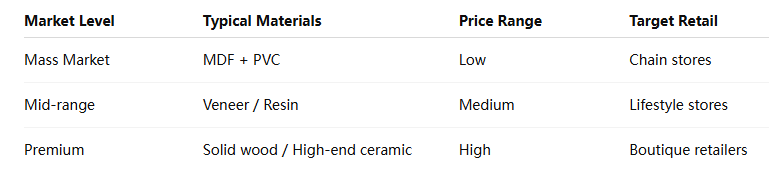
3.1 Low-End Mass Market
This segment focuses on volume, competitive pricing, and fast turnover. Products must be cost-efficient and easy to produce in large quantities.
Common material combinations include:
- MDF with PVC coating
- Resin with simple spray finishing
- Thin metal with basic powder coating
MDF with PVC coating is a typical example. It allows stable structure at low cost and supports printed or laminated finishes that imitate wood texture. For chain retailers or online marketplaces, this combination supports aggressive pricing while maintaining acceptable visual quality.
However, the trade-off is lower durability and simpler finishing details. Buyers in this segment must control production consistency and packaging efficiency to protect margin.
3.2 Mid-Range Lifestyle Stores
Mid-range retailers focus on design appeal and balanced pricing. Customers expect better texture and improved finishing quality compared to entry-level products.
Typical material choices include:
- MDF with veneer finish
- Resin with hand-painted details
- Thicker metal with improved coating
- Standard ceramic collections
In this positioning, material quality must feel more authentic. For example, veneer-covered MDF provides a more natural appearance than PVC coating. Resin products may include more detailed finishing to enhance perceived craftsmanship.
Margins are usually higher than mass market, but so are customer expectations. Quality inspection becomes more important because small finishing defects can affect brand image.
3.3 Premium Boutique Retailers
Premium retailers emphasize craftsmanship, authenticity, and storytelling. Material selection becomes part of the brand narrative.
Common material combinations include:
- Solid wood with hand finishing
- High-quality ceramic with refined glazing
- Heavy metal with advanced surface treatment
- Thick glass with precise edge polishing
Solid wood with hand finishing clearly supports premium positioning. Natural grain patterns and manual surface treatment create uniqueness that mass-produced MDF cannot replicate.
In this segment, buyers are less focused on minimum price and more focused on material authenticity, compliance documentation, and production stability. Lower order volumes may be acceptable, but quality tolerance is much stricter.
3.4 Why This Matters for B2B Buyers
Material choice directly affects:
- Target retail channel
- Acceptable price range
- Packaging standards
- Customer complaint risk
- Brand perception
A simple wall frame design can enter the mass market when made with MDF and PVC coating. The same design can move into premium boutiques when produced with solid wood and hand-finished details. The structure looks similar, but the positioning, margin, and customer expectations are completely different.
For wholesale home decor sourcing, material strategy should always be aligned with market positioning. Choosing the wrong material may not cause immediate production problems, but it can create long-term brand misalignment and margin pressure.
Professional buyers treat material selection as a strategic decision, not just a production detail.
4. Hidden Risks Buyers Often Ignore
In wholesale home decor sourcing, most problems do not appear at the sampling stage. They appear after mass production begins. Many buyers approve a beautiful sample, place a bulk order, and only discover issues when goods arrive at their warehouse.
This gap between sample and mass production is one of the biggest hidden risks in B2B sourcing.
4.1 Sample Looks Perfect, Mass Production Differs
The approved sample is often made with extra care. Factories may use better raw material, more experienced workers, or slower production methods to ensure the sample passes approval.
During bulk production, efficiency becomes the priority. Small adjustments may occur without clear communication. The visual difference may be subtle, but structural stability or finishing quality can change.
Without production-stage control, buyers only see the issue after shipment.
4.2 Material Substitution
Material substitution is a common cost-control behavior in some factories. For example:
- Switching from higher-grade MDF to lower-density board
- Using thinner wood panels
- Changing resin formulation
- Replacing metal thickness with lighter material
These changes may reduce factory cost but directly impact durability and customer satisfaction. In many cases, buyers are not informed because the product appearance looks similar at first glance.
This is why written material confirmation before production is critical.
4.3 Thickness Reduction
Thickness reduction is harder to detect visually but significantly affects product strength. A 2–3 mm reduction in wood, metal, or glass thickness can reduce cost at the factory level, but increase breakage rate during shipping or retail use.
For decorative shelves, frames, or wall-mounted items, reduced thickness may also create safety concerns.
Professional buyers should confirm technical specifications, not just appearance approval.
4.4 Surface Coating Downgrade
Surface finishing plays a major role in home decor quality perception. During bulk production, factories may:
- Use thinner paint layers
- Shorten drying time
- Apply lower-cost coating material
The product may pass basic visual inspection but show peeling, fading, or uneven texture after a few weeks of retail exposure.
Surface coating downgrade is one of the most common reasons for customer complaints in decorative products.
4.5 Packaging Downgrade
Even when the product itself meets requirements, packaging may be simplified to reduce cost. Thinner cartons, less inner protection, or lower foam density can increase breakage during sea freight.
For materials such as ceramic, glass, or thin wood panels, packaging quality is directly connected to final profit margin.
A good product with weak packaging still results in loss.

5. How to Control Material Quality When Sourcing from China
Controlling material quality is not a single action. It is a structured process that begins before production and ends only after final inspection. Below is a practical five-step framework that wholesale home decor buyers can apply to reduce sourcing risk.
Step 1: Confirm Material Grade in Writing
The first step is to clearly define material specifications in written form before production starts. This includes raw material grade, thickness, density, surface coating type, color standard, and packaging requirements.
Verbal confirmation is not enough. Many disputes happen because buyers assume factories will follow the approved sample exactly. A written material specification sheet creates accountability and reduces the chance of silent substitution or thickness reduction. Even simple decorative items should have basic measurable standards documented.
Clear documentation protects both parties and creates a professional sourcing foundation.
Step 2: Approve Pre-Production Sample
A pre-production sample should reflect real bulk production conditions. It should use the same material grade, finishing process, and packaging method planned for mass production.
Buyers should evaluate more than appearance. Check structural stability, thickness accuracy, coating consistency, and packaging protection. If possible, conduct basic functional or durability checks relevant to the product type.
This stage is the best opportunity to detect potential risks before scaling to thousands of units. Once bulk production begins, correction cost increases significantly.
Step 3: Conduct During-Production Inspection
Relying only on final inspection is risky. During-production inspection allows early detection of material changes or finishing inconsistencies.
At this stage, inspectors can verify:
Whether raw materials match confirmed specifications
Whether thickness standards are maintained
Whether surface treatment is consistent
Whether packaging materials meet agreed standards
Early detection prevents full-order defects. If a problem appears at 30% production progress, corrective action is still possible without severe delay.
For higher-value home decor orders, mid-production inspection significantly reduces long-term risk.
Step 4: Check Packaging Strength
Material quality control must include packaging verification. For fragile materials such as ceramic, glass, or thin wood panels, packaging directly affects breakage rate.
Buyers should confirm carton thickness, inner protection materials, and product fixation structure. For export shipments, carton strength must withstand stacking pressure and long-distance transport.
Packaging testing, including simple drop tests or compression checks, can prevent expensive damage claims after arrival. A well-made product with weak packaging still leads to loss.
Step 5: Final Shipment Inspection
Before shipment, a final inspection should confirm that bulk goods match approved standards. This includes visual quality, dimensional accuracy, surface finishing consistency, and packaging verification.
Random sampling during final inspection helps detect batch inconsistencies. Inspectors should compare production units with the approved pre-production sample and written material specifications.
Final inspection is the last checkpoint before goods leave the factory. Skipping this step may expose buyers to avoidable risk.
Material control in China sourcing is not about distrust. It is about building a structured verification process. When buyers implement written confirmation, sampling control, production monitoring, packaging checks, and final inspection, material-related problems can be significantly reduced.
In wholesale home decor, disciplined quality control protects margin, reduces breakage rate, and strengthens long-term supplier relationships.
Conclusion – Smart Material Choice Means Better Profit
In the wholesale home decor business, material selection is never just a design decision. It directly affects your cost structure, shipping damage rate, compliance exposure, and retail positioning. Every material choice influences how your product performs in the market and how much real profit you keep after logistics and returns.
A lower-cost material may help you win price competition in the short term, but it can increase breakage rate or customer complaints. A higher-grade material may increase initial cost, yet support premium pricing and stronger brand perception. The key is not choosing the cheapest option. The key is choosing the right material for your target market.
Smart buyers understand that:
- Material determines margin stability
- Material affects packaging and freight cost
- Material impacts long-term brand reputation
- Material alignment supports correct market positioning
The same home decor design made in resin, ceramic, MDF, or solid wood can result in completely different business outcomes. When material strategy matches your retail channel and pricing model, profit becomes more predictable and sustainable.
If you are sourcing wholesale home decor from China and want to reduce material risk, structured supplier evaluation and production inspection are essential. From material confirmation to warehouse-level quality checks, a professional sourcing process protects both product quality and your long-term growth.
In B2B home decor, smart material choice is not an expense. It is an investment in better profit and stronger brand positioning.

我负责网站的日常运营和内容管理。我的工作重点是优化用户体验、提升网站性能,并确保客户能够轻松找到所需的产品和服务。我与采购和客户服务团队紧密合作,确保网站内容及时更新,提供可靠的信息、清晰的产品详情和实用的资源。我的目标是使我们的平台不仅成为一个商业工具,更成为国际买家的宝贵指南。